
Blog / October 18, 2026
Online ordering feesWho pays the online ordering fee: the restaurant or the guest?
Short answer: it depends on the platform. Delivery apps charge the restaurant a commission, typically 25–30% of every order. Direct ordering tools charge much less, and many let the guest pay a small fee at checkout instead. With Ser.vi, the restaurant pays 0% commission and no monthly fee, and the guest pays a 5% convenience fee at checkout, which covers card processing and the platform. You keep the order total.
Competitor fees are from each company's own website, read October 17, 2026 (Owner.com re-checked October 18, 2026). Ser.vi fees from our pricing page.
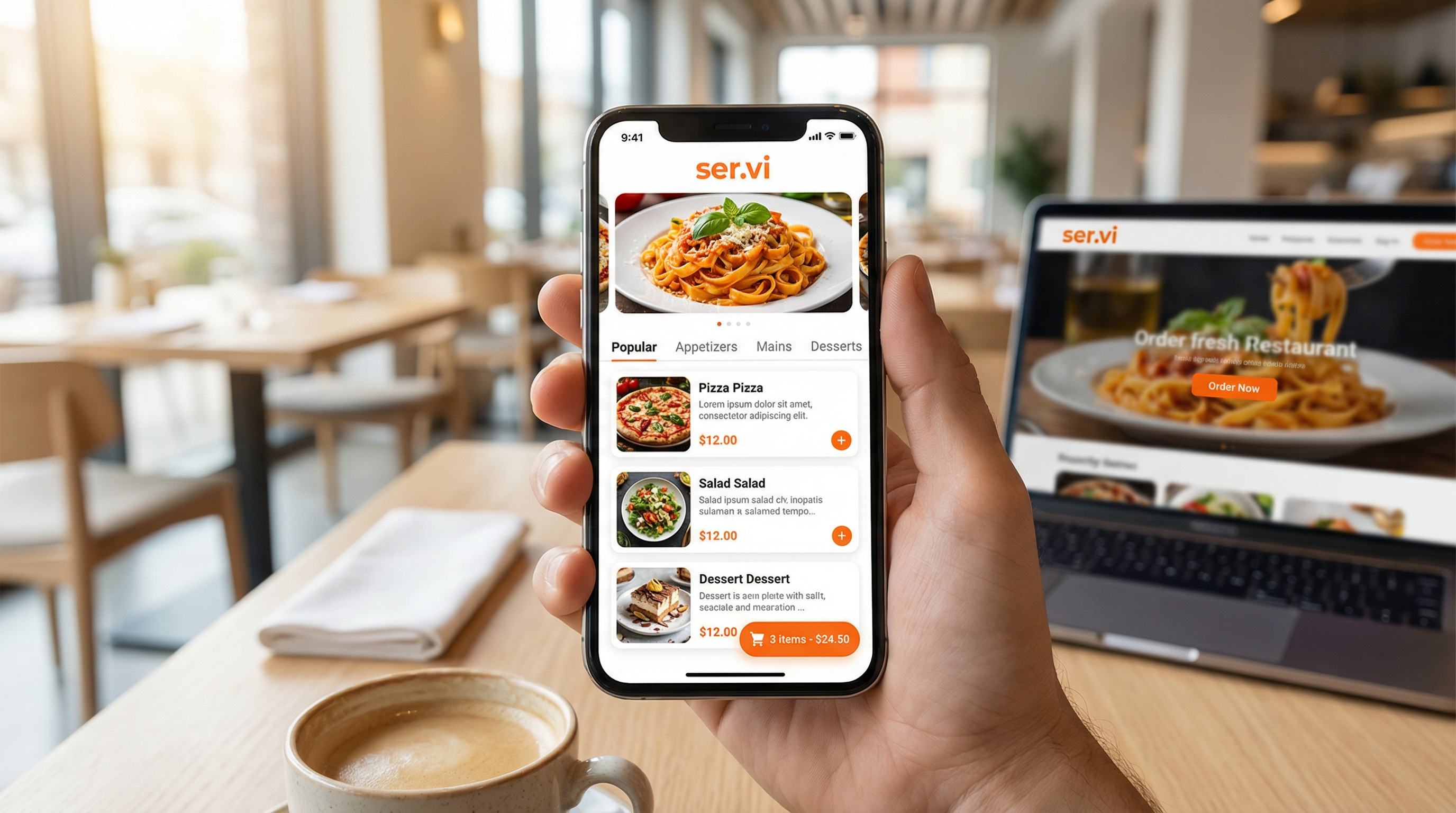
The four ways online ordering gets paid for
- Commission, paid by the restaurant. Delivery apps take a percentage of each order, typically 25–30%. The guest often pays service and delivery fees on top.
- Monthly subscription, paid by the restaurant. A flat software fee, with card processing on top. Some plans also add a per-order or percentage fee.
- Flat per-order fee, often paid by the guest. For example, TapThru charges $1.25 an order and lets the restaurant decide who pays it; Ginger Direct's customer pays $1 an order; OrderOrBook charges $1 on orders of $20 or more. Card processing is usually separate and paid by the restaurant.
- Percentage fee, paid by the guest. The guest pays a percentage at checkout. Ser.vi works this way: a 5% convenience fee covering card processing and the platform, so the restaurant pays nothing out of pocket. Owner.com's guests also pay 5%, alongside a monthly plan the restaurant pays.
Other models mix these. Toast lists a $0.99 guest fee for a limited pool of participating merchants, shown to guests as an "Online Processing Fee"; it can't be split, but the restaurant can choose to absorb it. Upserve lists a 2.99% online ordering service fee the restaurant can absorb, pass on, or split.
Competitor fees are from each company's own website, read October 17, 2026. Check their sites for current pricing.
Who pays what on a $35 order
Example math for illustration, not a quote. Card processing for the flat-fee column uses the 2.9% + 30¢ rate TapThru shows in its own example; your rate may differ.
| Ser.vi | Flat $1.25 fee, guest pays | Delivery app | |
|---|---|---|---|
| Commission the restaurant pays | $0 | $0 | 25–30% ($8.75–$10.50) |
| Fee the guest pays | $1.75 (5% convenience fee) | $1.25 | Set by the app |
| Card processing the restaurant pays | $0 (included in the guest's 5%) | about $1.35 | Varies |
| Restaurant's cost on this order | $0 | about $1.35 | $8.75–$10.50 plus |
Ser.vi: get.ser.vi/pricing/. TapThru example rate: tapthru.com, read October 17, 2026. Delivery-app commission: typical 25–30% range.
And on a $100 order
Same assumptions as above.
| Ser.vi | Flat $1.25 fee, guest pays | |
|---|---|---|
| Fee the guest pays | $5.00 | $1.25 |
| Card processing the restaurant pays | $0 | about $3.24 |
| Restaurant's cost | $0 | about $3.24 |
The honest takeaway
With Ser.vi the restaurant's cost is $0 on every online order, at any size. A flat guest fee is smaller for the guest on big orders, but the restaurant still pays card processing, and that grows with the ticket.
Added together, guest fee plus restaurant cost come out about even at roughly a $75 order in this example. Below that, Ser.vi's total is lower; above it, a flat fee plus processing is lower. Either way, both are a fraction of a 25–30% delivery-app commission.
Will guests mind paying a fee?
Guests already pay service and delivery fees on delivery apps, often on top of marked-up menu prices. On a direct order the fee is smaller and stated up front. On Ser.vi it is called a convenience fee and is shown at checkout before the guest pays. What matters most is being clear:
- Show the fee before the guest pays, with a plain label that says what it is for.
- Keep your online menu prices the same as your in-store prices, so the fee is the only difference.
- Tell regulars why you moved to direct ordering: more of their money stays with your restaurant.
Fee rules to check in your state
Rules differ by state and city, so check yours before you launch. Two examples:
- California: the Honest Pricing Law (SB 478) requires listed prices to include mandatory fees. SB 1524 exempts restaurant fees that are clearly and conspicuously displayed, with an explanation of their purpose, wherever prices are shown. Since July 1, 2025 that disclosure must stand out from the surrounding text. See the California Attorney General's page (read October 17, 2026).
- Convenience fee vs. card fees: the Wisconsin Restaurant Association describes a convenience fee as a charge for the ease of ordering online, not for paying by card, which must be communicated before the transaction is completed. Fees charged for paying by card follow separate card-brand rules.
This page isn't legal advice.
How Ser.vi's online ordering fee works
- 0% commission and no monthly fee for online ordering.
- The guest pays a 5% convenience fee at checkout. It covers card processing and the platform, per our pricing page.
- You keep the order total.
- No contract for online ordering.
- Delivery is optional. Delivery fees go to the delivery provider, not Ser.vi, starting at $6.50 plus tip.
- Same menu as your POS, and the customer data is yours.
See how commission-free online ordering works, or compare models in our DoorDash alternative and ChowNow alternative guides.
Questions restaurants ask
- Who pays the online ordering fee with Ser.vi?
- The guest pays a 5% convenience fee at checkout. The restaurant pays 0% commission and no monthly fee for online ordering.
- What does the 5% cover?
- Card processing and the platform, so online ordering costs the restaurant nothing out of pocket.
- What does the guest see at checkout?
- A 5% convenience fee, shown at checkout before the guest pays.
- Is a flat per-order fee cheaper than a percentage fee?
- For the guest, a flat fee is cheaper on larger orders. For the restaurant, it depends on who pays card processing. With Ser.vi it is included in the guest's 5%, so the restaurant pays $0 on every online order.
- Can I pass online ordering fees to customers?
- Many direct ordering platforms let you, as long as the fee is clearly shown before the guest pays and you follow your state's rules. With Ser.vi, the guest pays the 5% convenience fee at checkout.
- How does this compare with delivery apps?
- Delivery apps typically charge the restaurant a 25–30% commission. On a $35 order that is $8.75–$10.50, against $0 for the restaurant with Ser.vi.
See your numbers on Ser.vi
Free personalized demo. No commitment, no credit card. Bring your average order size and we'll walk through who pays what.
By requesting a demo you agree to our Privacy Policy.