
Blog / October 18, 2026 · Educational overview, not legal advice
Card fees, explainedCash discount vs surcharge for restaurants: what's the difference
Short answer: A cash discount posts the card price as the regular price and lowers it when the guest pays cash. A credit card surcharge adds a fee on top of a lower base price when the guest pays by card. The totals can look similar; the reference price and the math at the POS decide which one you are running. Rules for both vary by state and card brand. On Ser.vi, the POS fee is 3.0% + 20¢, paid by the restaurant by default, and a cash discount program is available to pass it on. Most of our POS restaurants use it.
Not legal advice. Card-brand rules and state laws change; confirm your setup with your processor and counsel before you go live. Ser.vi fees from our pricing page.
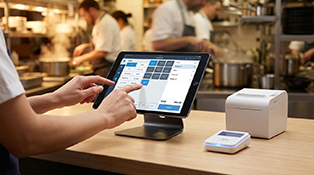
Cash discount vs surcharge in one table
A plain-language summary for restaurant owners.
| Cash discount | Credit card surcharge | |
|---|---|---|
| Posted / menu price | The card (regular) price | Usually a lower cash or base price |
| What the guest sees at payment | Cash payers get a discount off the posted price | Card payers see an added fee for using a credit card |
| Typical framing | "Cash price is lower" | "Credit card fee applies" |
| Rules | Vary by state and card brand; disclosure required | Vary by state and card brand; card brands set notice, caps, and debit/prepaid rules |
| POS math tell | Card total = posted card prices; cash = that total minus a labeled discount | POS starts from a cash subtotal and adds a % for cards |
Not legal advice. Confirm your state rules and card-brand requirements with your processor and counsel before you launch a program.
Why the framing matters: the math tell
Restaurant owners often hear "cash discount" and "surcharge" used interchangeably. They are not the same.
Cash discount: guests who pay cash pay less than the posted price. The posted price is what card guests pay. Receipts should show a cash discount, not a "card fee" for using a card.
Surcharge: guests who pay by credit card pay more than a lower posted base. Card brands commonly require advance notice to the processor, signage, receipt disclosure, and no surcharge on debit or prepaid cards, and some states restrict the practice.
Compliance writers watch the arithmetic, not the marketing label. If your POS starts from cash item prices and then adds a percentage line for cards, that is surcharge math even if the program is sold as "cash discounting." Prefer a setup where the menu and POS show the card price (or both prices side by side), and cash simply receives a clearly labeled discount.
For a vendor-published primer on how cash discounting works, see Toast's Cash Discounting Overview.
Signage, menus, and receipts: a practical checklist
Use this as a pre-demo checklist, not a guarantee of compliance:
- Decide the model before you reprint menus. Cash discount and surcharge need different posted prices and different POS setup.
- Disclose before the order. Signage is required: entrance and point-of-sale signs should say that listed prices are card prices and that cash receives a discount (or show both prices).
- Match the receipt language. Show "cash discount" when cash pays.
- Train the floor. Staff should explain "cash is discounted from our posted price."
- Debit and prepaid. Card-brand rules treat these differently from credit. Ask your processor.
- Check your state. Rules vary by state and card brand. Get a local answer before launch; don't rely on a blog post.
How this ties to Ser.vi POS pricing
On Ser.vi, POS software has no monthly fee. Staff-entered POS orders use a rate of 3.0% + 20¢ per transaction, paid by the restaurant by default. A cash discount program is available to pass that cost on to customers, and per our pricing page, most of our POS restaurants use it. Signage is required, and we'll help you set it up on a demo.
Online ordering is a separate path: 0% commission to the restaurant, and the guest pays 5% at checkout.
Hardware is separate and offered on terms. POS and online ordering software have no contract. Related: Integrated restaurant POS · No-contract restaurant POS · Is a free restaurant POS really free? · Toast POS alternative
When a cash discount fits, and when it doesn't
Often a fit when
Often a poor fit when
Questions restaurants ask
- Is a cash discount the same as a credit card surcharge?
- No. A cash discount lowers the posted price for guests who pay cash. A surcharge adds a fee for paying by credit card. Labeling a surcharge as a "cash discount" does not change how card brands or regulators may treat the math.
- Is a cash discount legal for restaurants?
- Rules vary by state and card brand. In general, a cash discount is a true discount from the posted price, offered to cash payers and clearly disclosed. Confirm the rules for your location with your processor and counsel. This page is not legal advice.
- Can I just add 3% at the end for card payments?
- Adding a percentage to card payments is surcharge-style math. Whether it is allowed depends on state law and card-brand rules, and card brands commonly bar surcharging debit and prepaid cards. Talk to your processor before enabling anything like that.
- How does Ser.vi handle POS card fees?
- By default the restaurant pays 3.0% + 20¢ per POS transaction. You can pass it to customers with a cash discount program, and most of our POS restaurants do. Online ordering is separate: the guest pays 5% at checkout and the restaurant pays 0% commission.
- Do I need signage for a cash discount program?
- Yes. Disclosure is part of running a cash discount program, including signage. We'll help you set it up on a demo.
- Does Ser.vi charge a monthly POS subscription?
- No. There is no monthly fee for POS and online ordering software. Hardware is separate. Optional marketing plans are billed separately if you want them.
See a cash discount on a live POS ticket
Free 20-minute demo. We'll show how the program works on Ser.vi POS and help you set up signage.
By requesting a demo you agree to our Privacy Policy.